Insight • Family and marriage
Thailand became the first country in Southeast Asia to open civil marriage to any two people. For couples living in Phuket, including couples where both partners are foreign nationals, this is no longer a question of recognition. It is a question of paperwork.
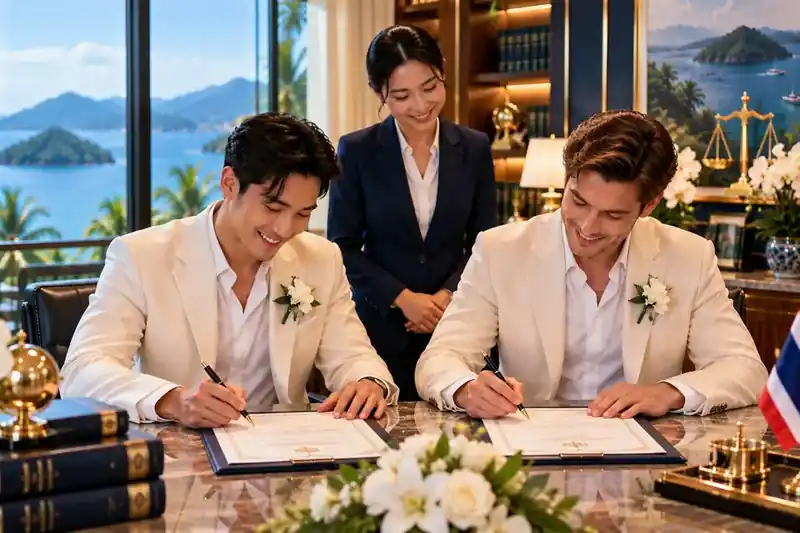
The Marriage Equality Act was published in the Royal Gazette on 24 September 2024 and came into force 120 days later, on 23 January 2025. It amends the Civil and Commercial Code so that marriage is a partnership between two people rather than between a man and a woman, and it replaces gendered wording throughout the marriage provisions.
Once registered, spouses have the ordinary rights that follow marriage under Thai law: to manage and inherit each other's property, to adopt children, to divorce through the ordinary process, to access state welfare where one spouse is a government official, and to apply for citizenship on the basis of the marriage.
That inheritance point matters more than it sounds. A couple without a registered marriage and without a Thai will can find that property held in Thailand passes to relatives abroad rather than to the surviving partner, and that the survivor spends a year in the Thai courts proving a connection that a marriage certificate would have settled in a morning.
The minimum age is 18. Between 18 and 20 a person is still a minor for several purposes under Thai law, and parental consent is required.
Registration takes place at a district office, the amphoe. Foreign nationals are normally asked for an affirmation of freedom to marry from their own embassy in Thailand, translated into Thai and legalised by the Ministry of Foreign Affairs, together with passports and, where relevant, proof that any previous marriage has ended. Thai embassies and consulates abroad were also prepared for registration when the law took effect.
The practical difficulty is rarely the Thai side. It is the embassy step, which differs from country to country and takes anything from a day to several weeks, and the translation and legalisation chain that follows it.
A prenuptial agreement in Thailand has to be registered together with the marriage to be effective. It cannot be added afterwards in the way couples often assume. For couples who own property, run a business, or hold assets in more than one country, this is the moment to decide, not later.
Talk to us
Thai and foreign, two foreign nationals, same sex couples. We prepare the documents, deal with the embassy and the district office, and draft the prenuptial agreement so that it is registered with the marriage and valid in Thailand.
This article is general information about Thai law and not legal advice on your situation.